Paint colors for kitchen walls are easier to choose when you start with the cabinets, counters, backsplash, flooring, and hardware already in the room. In a Mercer Island kitchen, those fixed finishes usually carry more visual weight than the wall color, so the walls should support the materials instead of competing with them.
The best process is to narrow the undertone first, decide how much contrast you want, then test the finalists under the kitchen lighting you actually use. That gives you a color plan built around the room instead of around a sample photo online.
Start With the Cabinets Before You Pick the Walls
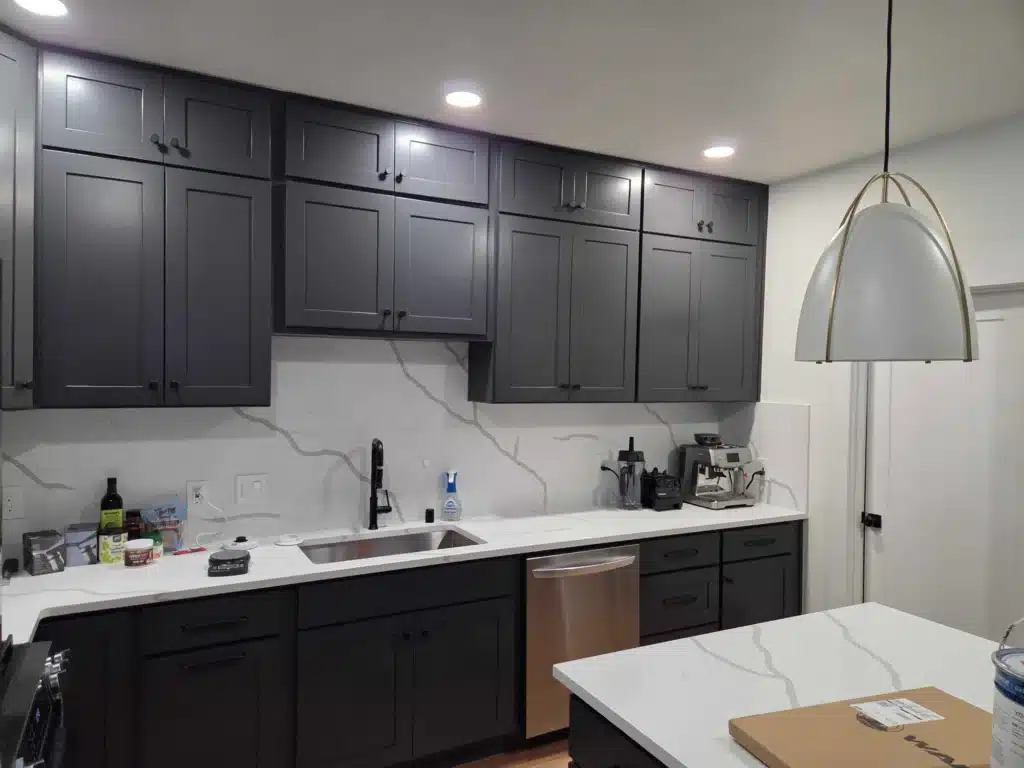
Cabinets take up a large share of the visible kitchen, so they should be one of the first references for wall color. White cabinets, stained wood, painted green, dark navy, or black cabinetry all create different limits for the walls around them.
If the cabinets are staying, compare wall samples directly against the doors and boxes. If the cabinets are being repainted, choose the cabinet and wall colors together so the pair feels intentional.
For cabinet projects, Tera Painting treats cabinet refinishing as a separate service from standard wall painting because the prep, products, and application process are different.
Use Countertops and Backsplash to Narrow the Undertone
Countertops and backsplash tile often contain several colors at once. Quartz, quartzite, granite, marble, ceramic tile, and stone can carry gray, beige, cream, brown, green, or blue undertones that shift how a wall color looks nearby.
Hold the wall sample beside the counter and backsplash instead of judging it on an empty wall. A warm white can look yellow beside a cooler stone, while a cool gray can feel disconnected beside a cream or tan surface.
Removing the colors that clash with the fixed materials usually makes the final choice much easier.
Decide How Much Contrast the Kitchen Needs
A kitchen with dark cabinets may benefit from lighter walls if you want the cabinetry to remain the strongest visual element. A white or light-wood kitchen can support a deeper wall color if the room has enough visual balance elsewhere.
Contrast can also come from the island, backsplash, or hardware instead of the wall color. You do not need every surface to compete for attention.
Choose one or two areas to carry the strongest color, then let the remaining surfaces support them.
What the 2026 Kitchen Data Says About Color
The National Kitchen & Bath Association’s 2026 Kitchen Trends Report gives a useful view of current industry direction. In its survey of kitchen and bath professionals, 96% identified neutrals as popular kitchen colors, followed by greens at 86% and blues at 78%.
NKBA’s 2026 report also found that statement color is often moving to the backsplash, wallpaper, island, and decorative accessories rather than covering every kitchen surface.
That supports a practical approach for Mercer Island kitchens: use the walls as part of the full material plan, not as the only place where color has to happen.
Warm Neutrals Can Connect Wood, Stone, and White Finishes
Warm beige, khaki, cream, taupe, and soft off-white can work well when the kitchen already contains natural wood, warm stone, cream tile, or brass-toned hardware.
Sherwin-Williams selected Universal Khaki SW 6150 as its 2026 Color of the Year, showing how warmer neutrals continue to work as backgrounds for natural finishes and stronger accent colors.
Do not choose a warm neutral from the trend alone. Test it beside the exact cabinets and counters because a small undertone difference can become much more obvious across a full wall.
Muted Green or Blue Can Work as the Wall Color or the Cabinet Color
Green and blue both appear strongly in current kitchen trend data, but they do not have to go on the same surface. A muted green wall can work beside warm wood cabinets, while a deeper green or blue cabinet color can pair with quieter walls.
If the cabinets already carry a strong color, use the wall to create breathing room. If the cabinetry is neutral, the wall can carry more personality without making the kitchen feel busy.
The final combination should be tested beside the hardware, backsplash, and countertop instead of chosen from isolated color chips.
Lighting Can Change the Wall and Cabinet Relationship
Kitchens often combine daylight, recessed fixtures, pendants, under-cabinet lighting, and decorative fixtures. Each source can shift how warm or cool the same paint color looks.
Check wall samples during the day and again with the kitchen lights on. If under-cabinet lighting hits the backsplash and counter strongly, look at the wall color under that reflected light too.
A sample that works only in midday sun may feel very different during the hours when the kitchen is used most.
Wall Paint and Cabinet Coatings Should Be Chosen Separately
Kitchen walls and cabinets do different work. Walls need a finish that fits the room’s traffic, cleaning, and surface condition, while cabinets receive repeated contact and need a coating system designed for that level of wear.
Tera Painting uses Benjamin Moore products on residential interior painting. Cabinet refinishing follows a separate four-day spray process using Renner 643 primer and Renner 765 catalyzed topcoat, with doors and drawer fronts removed and finished off-site.
If you are considering cabinet refinishing with the wall repaint, see our cabinet painting services for the process and product details.
Test the Final Kitchen Palette Together
Once you have a few finalists, test the wall color beside the cabinet finish, countertop, backsplash, flooring, and hardware at the same time. That is the real kitchen palette.
View the samples from the main entry into the kitchen and from the adjoining dining or living space if the rooms connect. An open kitchen should work from both inside the room and across the larger sightline.
Keep the finalists in place long enough to see them under the lighting conditions you normally use before making the final choice.
How Tera Painting Handles Mercer Island Kitchen Projects
Tera Painting serves Mercer Island and other Greater Seattle communities with interior painting, cabinet refinishing, exterior painting, and commercial painting.
The company was founded in 2012 and has completed more than 1,200 projects. Tera Painting is licensed and insured under Washington contractor registration TERAPPC804NQ, is PCA accredited, and is a Google Guaranteed service provider.
Current company information confirms free estimates by phone, virtually, or on-site, written proposals, daily communication, Benjamin Moore products on residential painting, a 7-year workmanship warranty, and a lifetime product warranty on qualifying residential finishes. For standard wall painting, see our interior house painting services.
Frequently Asked Questions
What paint colors for kitchen walls work with white cabinets?
White cabinets can work with warm neutrals, muted greens, soft blues, or deeper wall colors. Compare the sample with the exact cabinet white, countertop, backsplash, and lighting before choosing.
Should kitchen wall color match the cabinets?
It does not have to match. The goal is for the undertones and contrast to work together so the walls, cabinets, counters, and backsplash feel like one plan.
Can I use a dark wall color with dark cabinets?
You can, but test the combination in the actual kitchen. Lighting, counter color, backsplash, flooring, and the amount of natural light all affect how heavy or balanced the pairing feels.
Should cabinet paint be the same product as wall paint?
No. Cabinets receive repeated contact and cleaning, so they need a coating system made for cabinet surfaces. Tera Painting uses a separate Renner primer and catalyzed topcoat system for cabinet refinishing.